2026 Cannabis Industry Statistics & Data Insights
How the U.S. cannabis industry is performing in 2026, and where it’s headed next. Last updated November 2026.
1. Market Size & Growth Trajectory
U.S. Sales
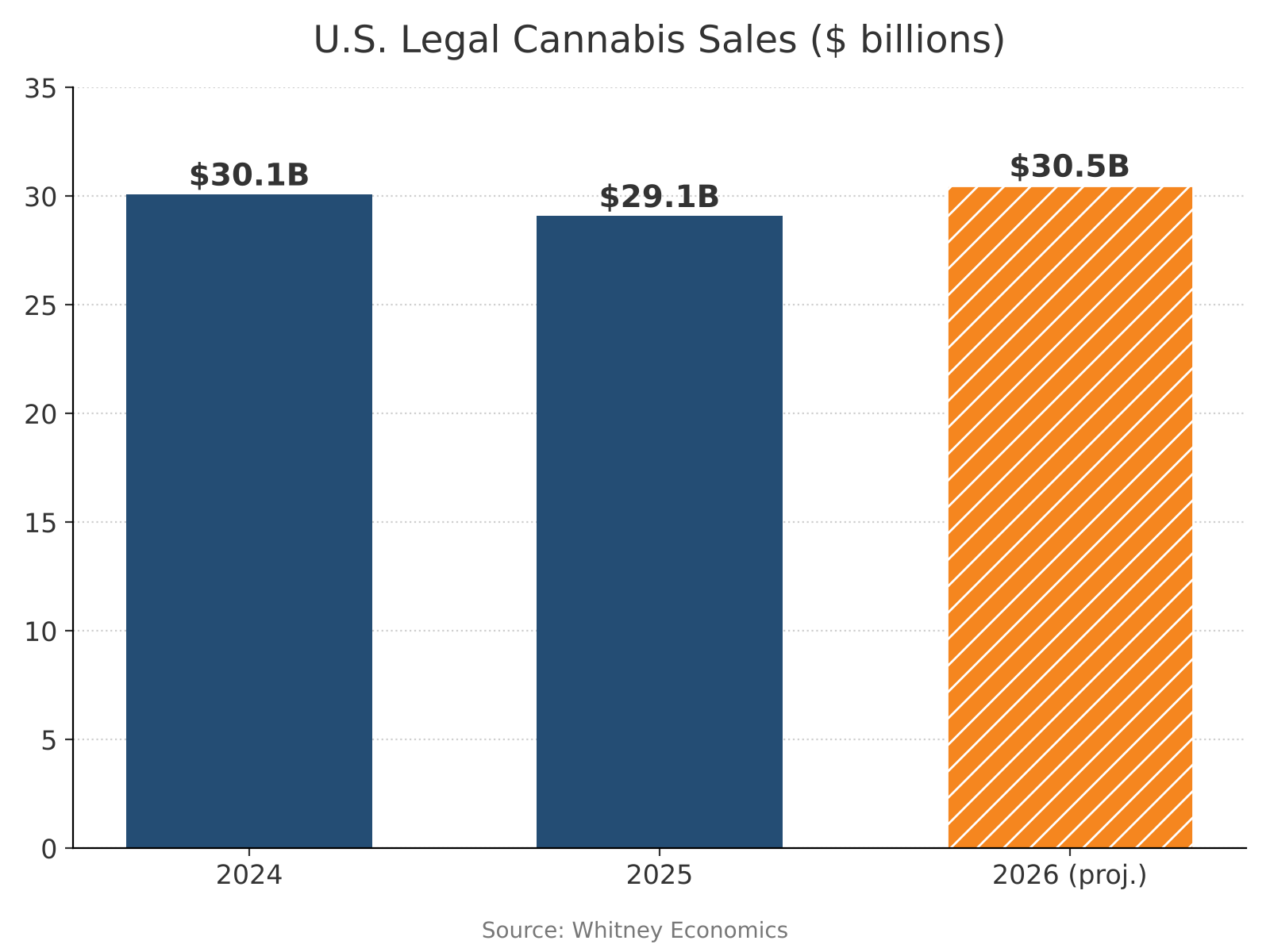
U.S. state-legal cannabis sales totaled $29.1 billion in 2025, down from $30.1 billion in 2024. It was the first annual decline after a decade of growth (Whitney Economics via NORML).
The dip reflects falling prices, not falling demand. Oversupply has pushed wholesale prices down (Vangst & Whitney Economics).
Sales are projected to rebound to $30.5 billion in 2026, a 4.9% increase (Whitney Economics).
Prices & Volume
Packaged flower prices fell 3.8% per gram year over year, and the average discount climbed to 27.1% of shelf price (Headset, 12 months ending September 2026).
Unit sales still grew 4.8%. Consumers are buying more product at lower prices (Headset).
The average cannabis item sold for $15.54 in September 2026 (Headset).
2. Economic Impact & Employment
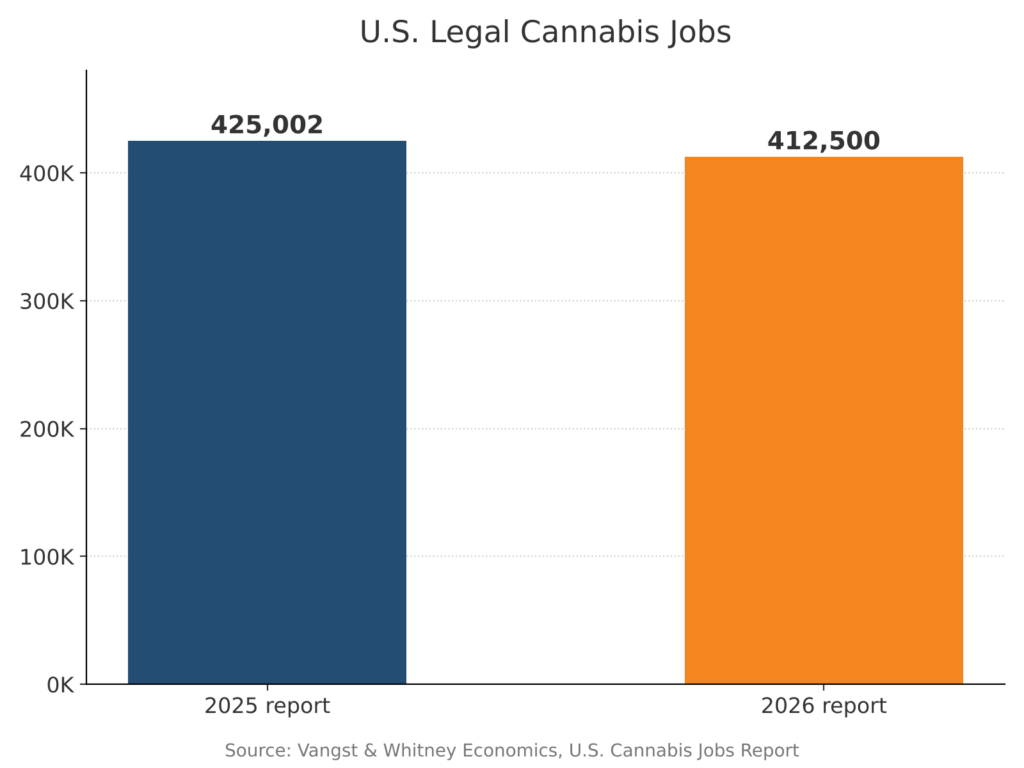
The legal cannabis industry employed about 412,500 people in early 2026, down from 425,002 a year earlier. It was the industry’s first year-over-year job decline (Vangst & Whitney Economics).
The top employment states are California (57,500), Michigan (42,500) and New York (28,660). New York and Maryland posted the biggest gains (Vangst & Whitney Economics).
States have collected more than $28.4 billion in adult-use cannabis tax revenue since 2014, including more than $4.57 billion in 2025 alone (Marijuana Policy Project).
3. Consumer Behavior & Demographics
64% of U.S. adults say marijuana should be legal, down from a high of 70% in 2023 (Gallup, October 2025).
Support is highest among younger adults: 72% of 18–34 year olds, 68% of 35–54 year olds and 57% of those 55 and older (Gallup via MPP).
Millennials drive 42.7% of cannabis spending, followed by Gen X (23.3%), Gen Z (21.7%) and Baby Boomers (12.4%) (Headset, 12 months ending September 2026).
Gen Z’s share of spending has grown from 18.4% to 21.7% in about two years (Headset).
4. Products & Pricing
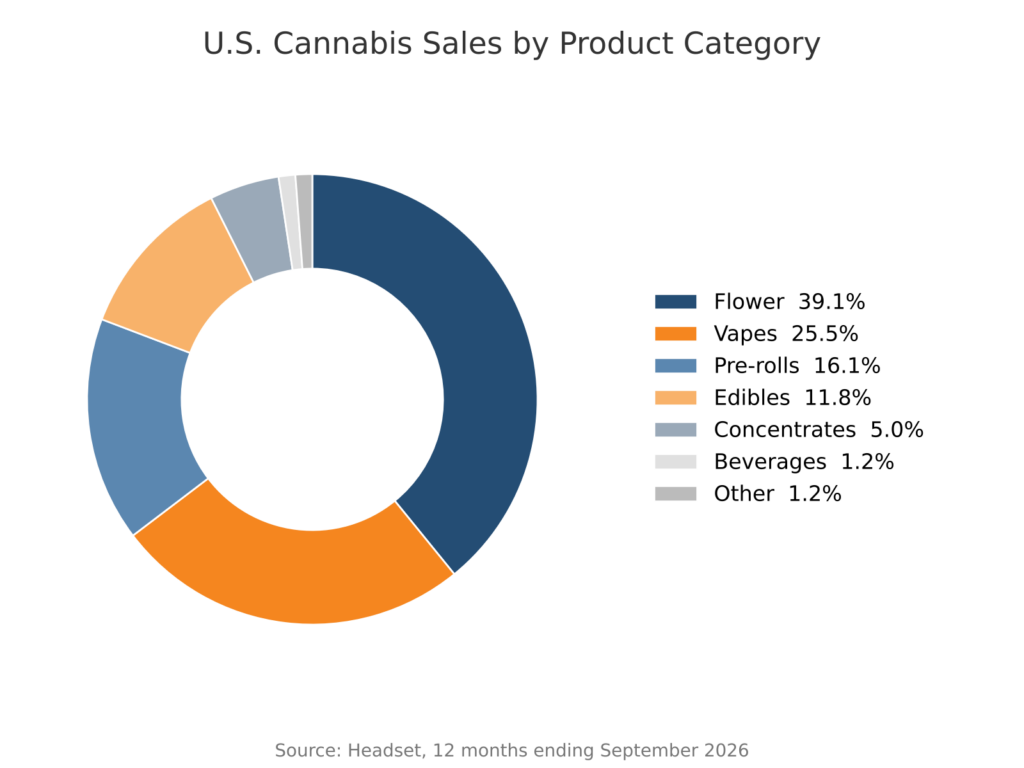
Flower remains the top category at 39.1% of sales, followed by vapes (25.5%), pre-rolls (16.1%), edibles (11.8%), concentrates (5.0%) and beverages (1.2%) (Headset, 12 months ending September 2026).
Pre-rolls are the fastest-growing major category, up 10.7% year over year. Beverages grew 9.3% from a small base (Headset).
Flower averages $8.09 per gram, $20.23 per eighth and $47.83 per ounce nationally. Eighths range from $12.74 in Oregon to $29.54 in Ohio (Headset, September 2026).
5. Legalization & Regulatory Trends
As of mid-2026, 24 states and Washington, D.C. have legalized adult-use cannabis, and about 40 states have comprehensive medical cannabis programs (Marijuana Policy Project).
On April 23, 2026, the Department of Justice moved state-licensed medical marijuana and FDA-approved marijuana products to Schedule III, effective April 28, 2026 (Gibson Dunn).
Adult-use cannabis remains in Schedule I. A DEA hearing on moving all marijuana to Schedule III began June 29, 2026, and a final rule could come as soon as late 2026 (Foley Hoag).
State-licensed medical operators are no longer subject to Section 280E as of April 2026. Adult-use operators still are. Operators should confirm their situation with a tax advisor (Foley Hoag).
6. Key Industry Challenges
Banking access remains limited. About 1,000 banks and credit unions reported serving cannabis-related businesses in 2024, a number that has held roughly steady since 2019 (GAO, citing FinCEN data).
Cannabis businesses still report high fees and difficulty accepting card payments, since major card networks prohibit cannabis purchases (GAO, 2026).
Rescheduling does not resolve banking. Financial institutions still apply Bank Secrecy Act and FinCEN guidance to cannabis clients (Foley Hoag).
Federal banking reform is still pending. The SAFE Banking Act of 2026 was reintroduced in the Senate on June 24, 2026 with bipartisan sponsors, but has not passed (Cannabis Business Times).
Price compression is squeezing margins. Falling prices pulled 2025 sales below 2024 even as unit volume grew (Whitney Economics; Headset).
7. Innovation & Emerging Trends
Pre-rolls and beverages are the growth stories, with pre-rolls up 10.7% and beverages up 9.3% year over year as consumers look for convenience and new formats (Headset).
AI and automation are improving everything from:
– Crop yield forecasting
– Compliance workflows
– Inventory and dynamic pricing
– Customer segmentation and loyalty programs (Cannabis Business Times).
E-commerce and digital loyalty tools have become table stakes for dispensary competitiveness (Springbig).
Sustainability is gaining focus: brands are exploring low-energy LED grows, biodegradable packaging, and water conservation techniques (Leafly).
8. 2026 Outlook

9. Paybotic Financial’s Role in a Changing Landscape
Business Banking: Business accounts, corporate debit cards, ACH and domestic wires built for the cannabis industry.
Data & Reporting: Tools that help businesses monitor transactions and support their compliance and reporting workflows.
Growth Enablement: Whether launching a new location or scaling operations across state lines, Paybotic Financial is your financial partner at every stage.
Final Takeaway
The cannabis industry in 2026 is working through a reset. Falling prices drove the first annual declines in sales and jobs, even as unit sales kept growing. Medical rescheduling has brought tax relief to some operators, but banking access and full federal reform remain unresolved. Operators that control costs, differentiate their products and build solid financial infrastructure are best positioned for what comes next.
Paybotic Financial is positioned to support that evolution, delivering the financial services, infrastructure, and insight cannabis businesses need to grow.